

Discussions of artificial intelligence in higher education are, as you might imagine or might have seen, highly polarized. For some, it is a radical break from the past, as represented most notably by Ethan Molick’s nearly evangelical work promoting AI (🙄). For others, it’s a just a plagiarism machine, a costly gimmick that has no place in pedagogy or higher education. This spectrum makes sense—we are flooded by all kinds of AI slop, from AI-generated articles from peers and essays from students to emails that use the increased throughput of these new technologies to scattershot multiple people with apparently individualized texts. I am somewhere in between. AI is definitely a slop maker—it’s writing is mediocre, lackluster, and entirely uninspired. But AI is also a time saver—good for dealing with tasks around data organization, quick non-mission-critical coding, and a lot of perfunctory, but quite meaningless work. I wouldn’t trust AI with a life-or-death medical diagnosis or preparing a paper for a journal submission. I would be much less concerned of using it to organize a spreadsheet or generate a custom website with limited use and very specific functionality.
This summer, I used AI in a way I hadn’t before: as an aid for creating a highly individualized course on popular culture that sought to engage directly with the likes and dislikes of students. What did this look like?
The course itself covered the classics: Adorno, Hall, Williams, Bourdieu, etc, etc. And like most other courses, it asked students to engage with current examples when making sense of, for example, massification, or the culture industry, or the organization of taste. Country, R&B, Netflix, Swift (Taylor, not the good one), and Marvel were all fair game. So far, this is a pretty traditional, hardly innovative course.
Where the course innovated was in leveraging AI in assessment. How? By creating individualized assignments for students that were tailored to their interests/disinterests. The motivation for this was straightforward: this was a new course so I could really experiment from the start, but it was also a remote, asynchronous course, so I wanted to do something that would avoid the superficial engagement and learning of these kinds.
The weekly individualized assessments were based on three things: a set of model questions that served as a template for what to expect from students for each week in terms of their understanding of specific concepts and that reflected the learning outcomes; a general rubric that could be used across assessments and that provided a benchmark for mine and their expectations; and individual data from a pre-course survey that asked students to declare their prior exposure to sociology, to the sociology of culture, as well as some questions about cultural capital and individual likes and dislikes (the dislikes were very important for getting students to make sense of various concepts). AI allowed creating a series of individualized questions, linked across weeks, and based on both the previous exposure that students had with sociology (making questions more challenging for them) as well as their declared cultural interests. (Like with any form of computational output, questions were checked and verified and corrected when needed; overall the approach is like what is possible in platforms like PrairieLearn). AI was also used to build an online deployment through Netify for students to access their questions using a unique ID.
This last point (the possibility of doing quick application deployments) was also used for a second component of assessment in the course: peer feedback. Our current LMS (Canvas) is terrible for routing unique assignments to individual students. But building an online deployment that does this with AI is relatively straightforward. This affordance was used to build a system in which students were shown 2 submitted assignments from other students and then asked to score and comment on them, based on the common rubrics. This provided an additional layer of structured, peer feedback for students, which complemented the feedback from the instructor (me!). This created a kind of conversation across the course, even if in a remote, asynchronous setting, where students would provide exceptional comments on their colleague’s work (in ways that, incidentally, are organically rare in the classroom; the fact that this was part of the grade also provided that little extra incentive to join). A similar deployment allowed students to see the feedback they received on their work.
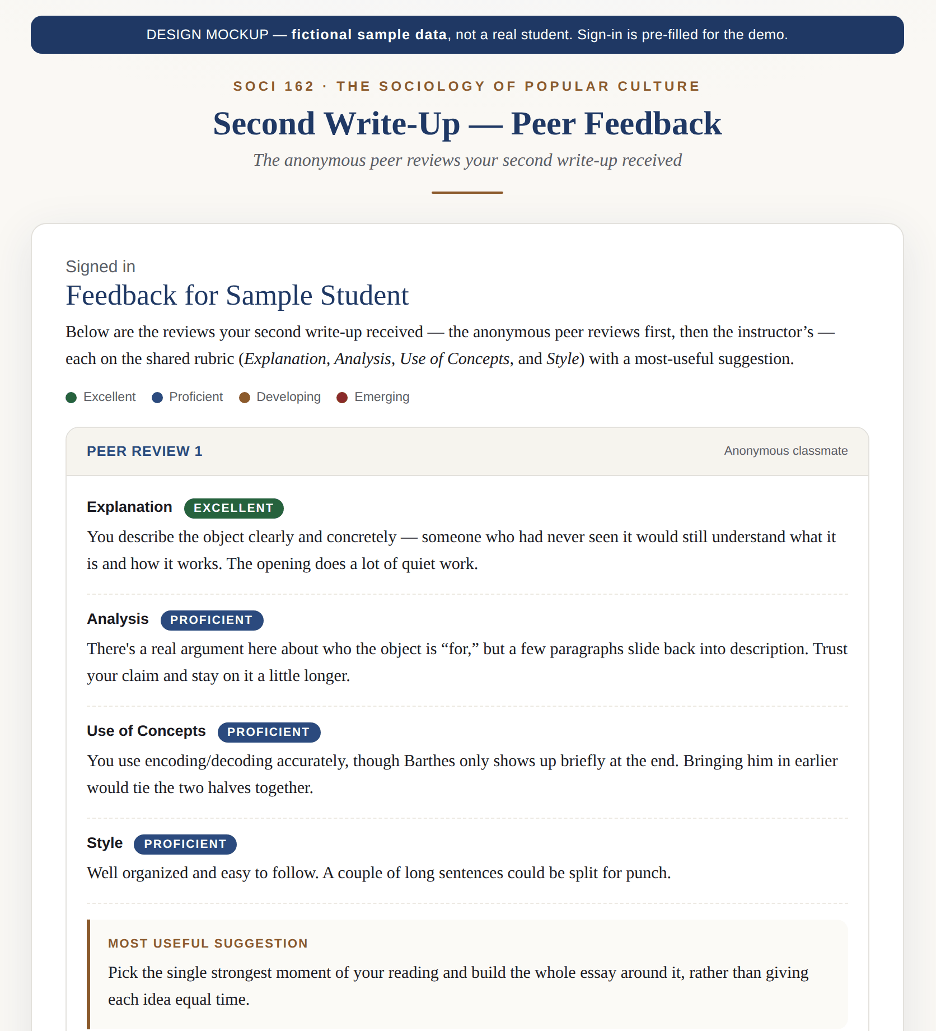
The result of this personalized approach to the course was overall good. On questions of assessment, students unanimously reported finding the assignments helpful for learning. (This came across in the final reflections, where it was clear that asking them to be reflexive about their cultural practices was key for their engagement.) And the qualitative comments they submitted in their evaluations also touched on the personalized approach. As one student wrote, “The instructor created a welcoming learning environment and encouraged us to share our own perspectives and examples. I liked that we could connect the course topics to different cultures, media, and personal experiences”. The sharing mostly happened through peer feedback, and it worked, grounding the work of students and helping them navigate the concepts in a more meaningful way.

Of course, there were some hiccups: this setup required students to be on time, always, which isn’t necessarily the case. It also required students to send the pre-course survey, which took some more than a few days after the session had started. But these are simple problems with simple solutions (building more slack into the system and better communicating expectations to students). Live and learn! Overall, though, this kind of use of AI seems like a legitimate pedagogical use case. It doesn’t challenge or substitute expertise, merely making processes that are essential for assessment more flexible and scalable. I would have never done this had it been necessary to create each assignment “by hand” (that’s about 300 prompts) or code each deployment from scratch. And that may be the most important ingredient: maintaining AI as an instrument for augmentation that, like any other instrument, has errors, requires supervision, and has particular scopes for use, but that can make possible setups that were largely prohibitively costly a few years ago.